Energy
Day-ahead photovoltaic production forecasting
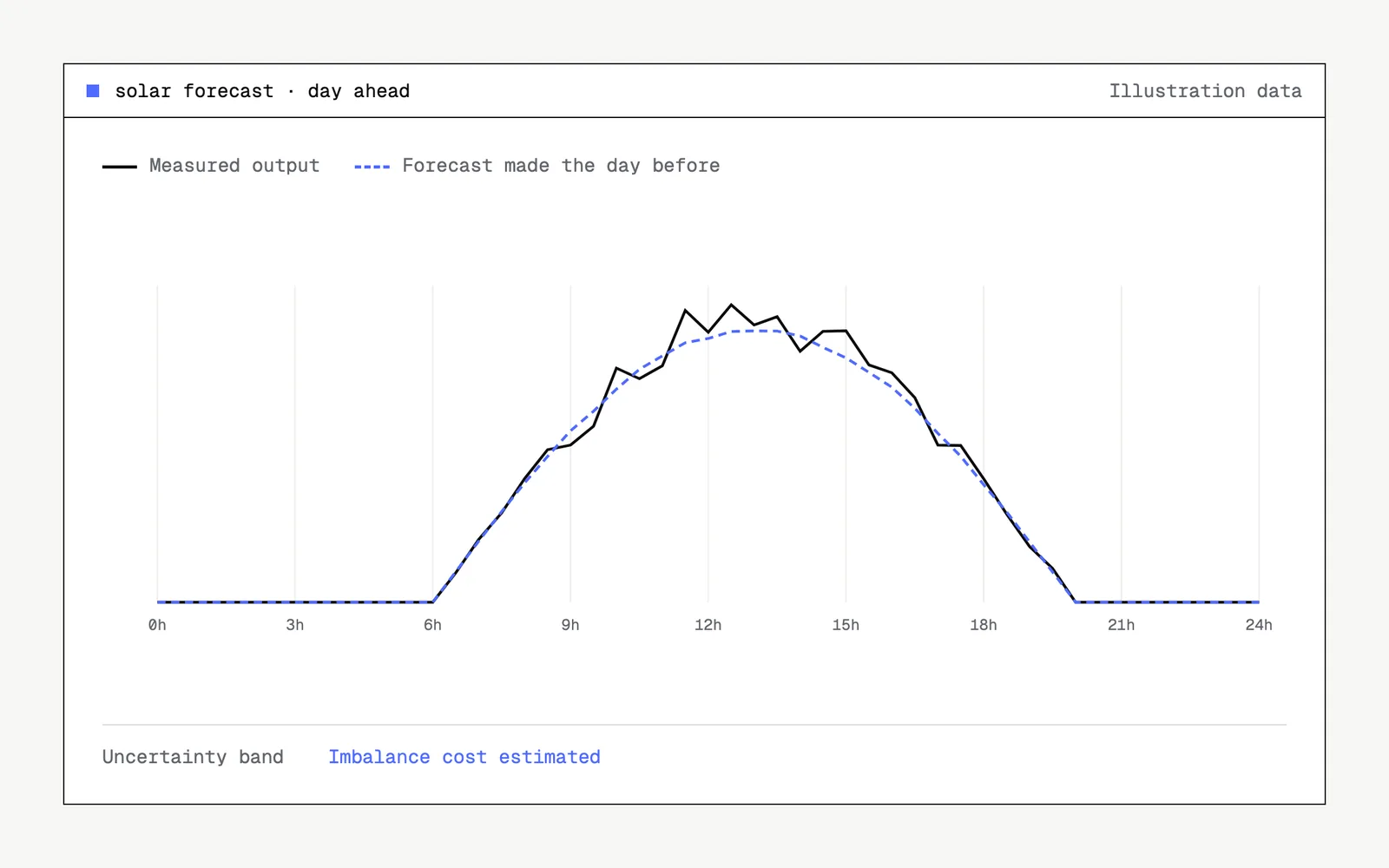
The engine produces an hourly production forecast for the following day, with an uncertainty range and an estimate in euros of the cost of deviations. The machine-learning forecast applies to plants whose telemetry is connected; the other plants remain on the physical model. On 23 days of real inverter data, persistence, the simple reference method, remains better.
Context
A large energy group operates solar plants and must announce the next day's production the day before; every deviation has a cost.
The problem
Establishing whether machine learning genuinely improves forecasting compared with a good physical model, using only data available the day before.
What we built
A forecasting engine deployable as a container (physical model, gradient boosting, time-series foundation model, combination chosen on validation), a calibrated P10-P90 range, a deviation cost model, an API and a monitoring screen integrated into the client's platform. Protocol frozen before evaluation and report generated by the code.
Steps
- 01Collection of day-ahead weather forecasts and open reference data
- 02Training and selection on validation, frozen test set
- 03Automatically generated report, test on real inverter telemetry
- 04Delivery of the engine and screen to the deployment team
Hosting and models
Engine in a Docker container, intended for the client's OVHcloud cloud; open weather data (archives of day-ahead forecasts, ERA5); LightGBM and Chronos-2 models, no GPU; optional briefings by a Qwen vision model.
Services involved
AI in your applications · Forward Deployed Engineers
We name a client only with their written agreement. The budgets and detailed results of our engagements remain confidential.