All sectors
Routing document pages before ingestion into an assistant
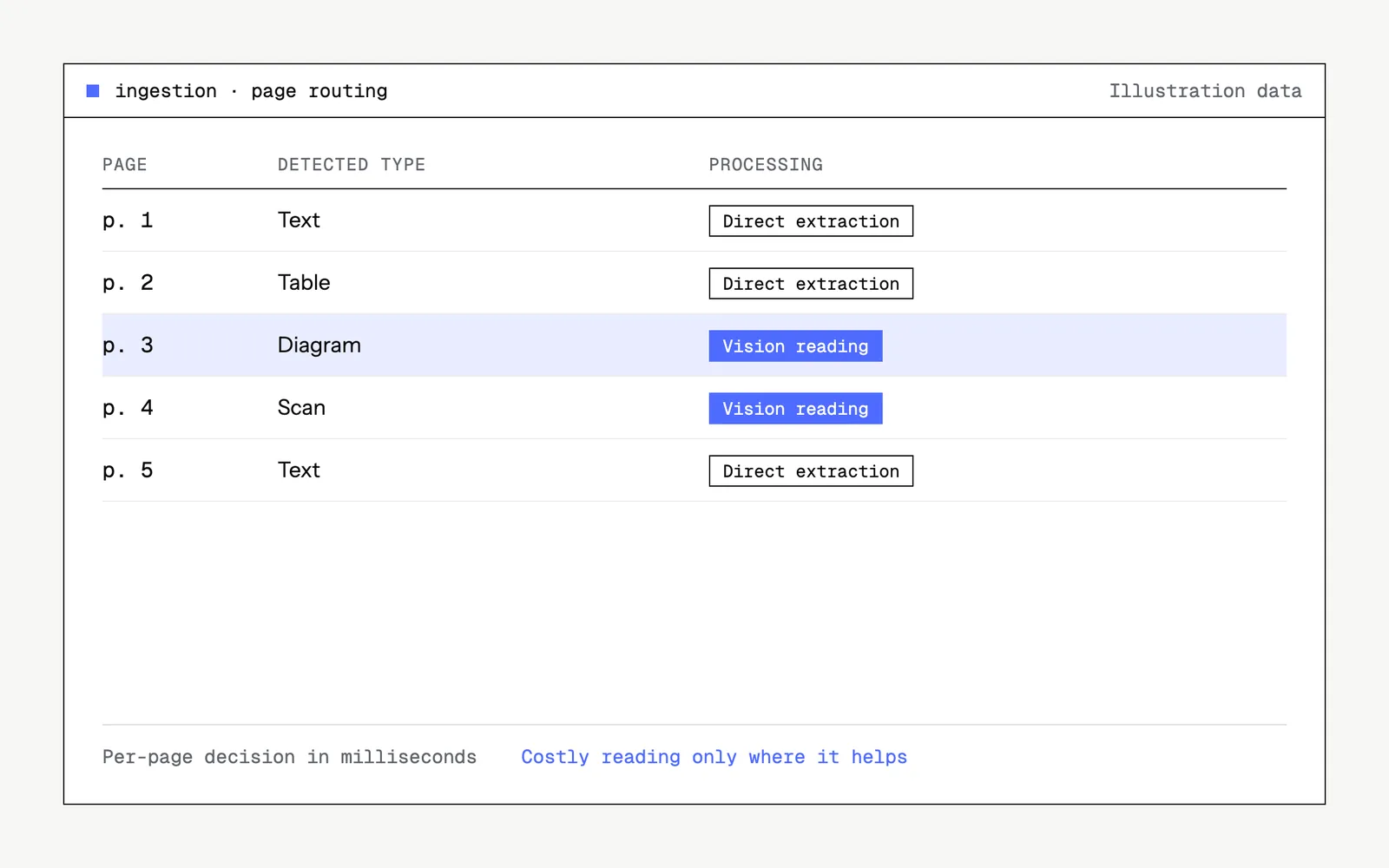
Each page of a PDF document is automatically routed either to free text extraction or to reading by a vision model, only when that is useful. The client ingests faster and pays for costly reading only on the pages that need it.
Context
An organisation feeds its AI assistant with internal documents synchronised daily from SharePoint: course materials, exams, procedures, charters.
The problem
Sending every page to a vision model is expensive and slows ingestion down; relying on native extraction alone loses figures, formulas and scanned pages.
What we built
A page-by-page router: a frozen visual encoder and three small classifiers predict whether native extraction will fail (useful image, formula, scan), plus two model-free text pre-filters. It runs on the GPU already used by the search pipeline, with no dedicated hardware.
Steps
- 01Building a corpus of 20 documents, 999 pages and 1,951 verification questions
- 02Training three decision heads on a frozen visual encoder
- 03Measuring the gain at equal cost, validated by a second annotator and replicated on a public benchmark
- 04Integration into the client's ingestion pipeline
Hosting and models
Frozen DINOv3 encoder (SigLIP 2 or DINOv2 possible, under the Apache 2.0 licence), inference on a T4 GPU shared with the embedder and the reranker. Vision model called for routed pages (Qwen3.5-2B and Gemini Flash evaluated).
Services involved
AI in your applications · Forward Deployed Engineers
We name a client only with their written agreement. The budgets and detailed results of our engagements remain confidential.